
Progressive Lenses vs. Bifocals: Which Is Right for You?

If you’ve hit your 40s and noticed that restaurant menus are suddenly written in a suspiciously small font, welcome to the club. You’re likely experiencing presbyopia, a natural, age-related change where the eye’s lens loses flexibility, making it harder to focus on close-up objects.
The good news? You don't have to carry three pairs of glasses around. The real challenge is deciding between the classic bifocal and the modern progressive lens.
In this blog, I’m breaking down the mechanics, the lifestyle impacts, and the "learning curve" of each. By the end of this guide, you’ll know exactly which frames deserve a spot on your face.
How They Work: The Mechanics of Sight
Before choosing, you need to understand the "under the hood" technology of your lenses.
1. Bifocals: The Traditional Choice
Bifocals are the "old school" solution, invented (legend has it) by Benjamin Franklin. The lens is divided into two distinct parts:
Top Half: Corrects for distance vision (driving, watching TV).
Bottom Segment: A visible "D-shaped" window that corrects for near vision (reading, sewing).
Because there is a sharp line separating the two powers, your eyes "jump" from one to the other. There is no middle ground, literally.
2. Progressive Lenses: The Seamless Upgrade
Progressive lenses, often called "no-line bifocals," are a feat of optical engineering. Instead of two sections, they feature a graduated slope of power.
Top: Distance vision.
Middle: Intermediate vision (perfect for computer screens or your car’s dashboard).
Bottom: Near vision (reading).
Progressives mimic natural vision more closely because they provide that "in-between" focus that bifocals lack.
Lifestyle Considerations: Which Fits Your Routine?
Choosing a lens isn't just about your prescription; it's about how you move through the world.
Choose Bifocals If...
You prioritize a wide field of vision: Because the entire bottom segment is dedicated to reading, you get a very wide "sweet spot."
You are budget-conscious: Bifocals are generally less expensive to manufacture than progressives.
You find "peripheral distortion" distracting: Progressives have slight blurring on the far left and right edges of the lens; bifocals do not.
Choose Progressive Lenses If...
You work on a computer: This is the dealbreaker. Bifocals lack an intermediate zone, meaning you might have to lean uncomfortably close to your monitor to see clearly. Progressives cover that 20–30 inch range perfectly.
You care about aesthetics: Many people prefer progressives because they don't have the visible "age line" associated with bifocals. They look just like standard single-vision glasses.
You want a "set it and forget it" experience: You can walk, drive, and read without ever feeling like your vision is "snapping" between two zones.
The Adjustment Period: What to Expect
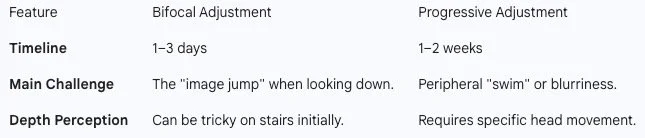
Moving into multi-focal lenses isn't like getting a new pair of shoes; it’s more like learning to ride a bike. Your brain has to learn how to process the new visual information.
Tips for a Smooth Transition
The "Point with Your Nose" Rule: With progressives, don't just move your eyes to look at something to the side. Turn your entire head. This keeps your pupils aligned with the "corridor" of clear vision in the center of the lens.
Stop "Toggling": Don't switch back to your old glasses because you're frustrated. This resets your brain's adaptation clock. Wear the new ones exclusively.
Tackle the Stairs Carefully: Initially, look over your glasses or tilt your head down further than usual when walking down stairs to avoid looking through the "reading" portion, which will make the floor look blurry.
Conclusion:
The "right" choice comes down to your digital habits and your tolerance for change.
If you spend eight hours a day at a desk and want a youthful look, Progressive Lenses are the gold standard. They offer a sophisticated, all-in-one visual experience that mirrors how we naturally see the world.
However, if you find the peripheral distortion of progressives dizzying, or if you simply want the widest possible area for reading and don't mind the "line," Bifocals remain a reliable, cost-effective tool.